Roan Horse
Killers of the Flower MoonRoan Horse was a forty-year-old Osage man whose killing made clear that the murders in Osage territory had not ended during the apparent lull. His life was marked by the forced changes imposed at boarding school, financial limits that led him to seek loans, and personal connections that would become important to investigators. He was also formerly married to Mollie Burkhart, a relationship that linked his death to a family already touched by violence.
Identity and Background
Roan Horse was married and had two children. Before boarding school, he had worn his hair in two long braids and used the name Roan Horse. At school, he was made to cut his braids and to change his name to Henry Roan. The two names therefore mark a change imposed on him, not simply two interchangeable labels: the man investigators identified was known publicly by the name the school had assigned, while his earlier name preserved a connection to an identity the institution had sought to alter.
The account describes him as tall and lean, with a long face that recalled an Osage warrior. That image stands in deliberate contrast to his institutional history. The physical description does not undo the forced changes of school; instead, it places the remembered figure of an Osage man alongside the record of what had been taken from him. His identity is presented through both the external labels imposed on him and the community and history those labels could not erase.
Death and Investigation
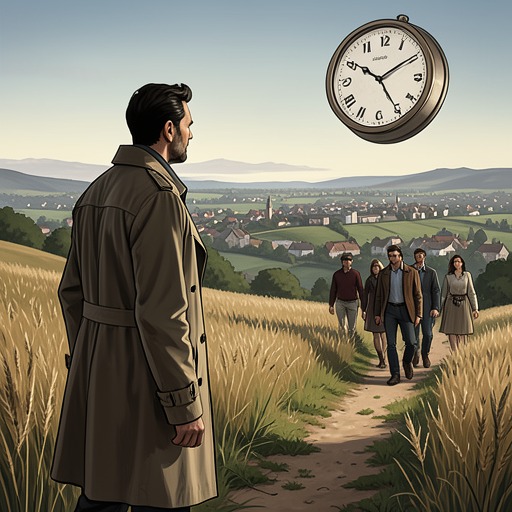
For nearly six months after the killing of McBride, investigators had found no further suspicious death. When two lawmen discovered Roan Horse in a car, the delay had seemed to suggest that the violence might have stopped. His identification overturned that impression. Unlike the earlier uncertainty surrounding other deaths, the lawmen recognized him at once, and his case showed that the lull had not meant the end of the killings.
The lawmen returned to Fairfax to notify the justice of the peace and ensured that William K. Hale was informed. At the coroner’s inquest, one of the Shoun Brothers, a doctor, estimated that Roan Horse had died about ten days earlier. Investigators recorded the position of his body, the shot that had broken the windshield, and fragments of glass on the hood and beyond the car. They also noted the money and gold watch he carried, as well as tire tracks in frozen mud nearby, which they thought might belong to another car. These observations established a set of circumstances for inquiry; the account does not identify the person responsible for the killing.
Friendship, Money, and Suspicion
Hale was described by Fairfax’s mayor as Roan Horse’s best friend. Roan Horse had often asked him for cash advances because his financial allowance had been curtailed. Hale later said that he had made many such loans and that Roan Horse had named him the beneficiary of a $25,000 life-insurance policy. The friendship thus had a material dimension: Hale was not only a confidant and source of help but also stood to receive the policy’s proceeds.
A couple of weeks before his death, Roan Horse called Hale in distress after learning that his wife was having an affair with Roy Bunch. Hale visited and tried to console him. That episode gives their friendship a personal setting shortly before the killing, while the policy and loans supply a separate financial context. Together, these facts explain why investigators made sure Hale was notified and why their relationship mattered to the case; they do not, by themselves, establish Hale’s role in Roan Horse’s death.
Marriage to Mollie Burkhart and Narrative Significance
The news of Roan Horse’s death jolted Mollie Burkhart because they had been briefly married in 1902, more than a decade before she met Ernest Burkhart. Mollie was fifteen at the time. The surviving accounts of the marriage are limited, and the narrative presents an arranged marriage as a likelihood rather than a certainty, placing it in the context of young people brought together to preserve a way of life under pressure.
Because the marriage followed Osage custom, the two did not need a legal divorce; they simply went their separate ways. The account suggests that the brief union ended without bitterness and may have left some warmth, while acknowledging that little is known about their relationship. Roan Horse’s death therefore reaches beyond the investigation: it returns Mollie to an earlier chapter of her life and makes visible a connection that had not disappeared merely because the marriage had ended.
His case carries several kinds of evidence at once: the consequences of forced schooling, the restrictions that shaped his dependence on loans, the personal bond with Hale, and a former marriage that connected him to Mollie. Most decisively, his discovery after months without another suspicious death changed the meaning of that silence. The killings had not stopped; Roan Horse’s death made the continuing danger unmistakable.